Cemeteries and graveyards, full of love, betrayal, tragic deaths, murder, and suicide. What will you find?
Showing posts with label war grave wednesday. Show all posts

Wednesday, 12 June 2013

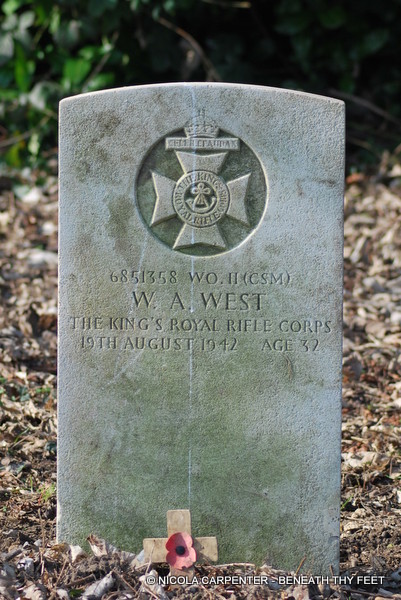
Commonwealth Second World War Grave - Warrant Officer Second Class, Sergeant Major William Alfred West - Met With A Fatal Accident


They shall grow not old, as we that are left grow old:
Age shall not weary them, nor the years condemn.
At the going down of the sun and in the morning,
We will remember them.


William Alfred West was born on 12th October 1909 in Maidenhead, Berkshire to Christopher Charles West, a refreshment house keeper, and his wife Louise Garraway.
 
William first appears aged one year old on the 1911 Census, living with his parents and older brother Christopher John West at 8 Bridge Street, Maidenhead Berkshire.  Living with the family at the time is William's paternal grandmother Mary Ann West. The family are still at 8 Bridge Street on the 1921 Census, living with the family is William's paternal uncle Frederick West, a waterman. Boarding with the family is Vetsa Linda Eva Allen, who is working in Charles West's refreshment house, and Alfred Hawkes, who is a printing compositor. 

In 1939 William was assisting his father in the refreshment house business, as well as his brother Christopher, and his sister-in-law Evelyn West. Living with the family is William's young nephew Robert West.  Helping towards the war effort William is an Auxiliary Fireman and his brother Christopher is an Air Raid Warden.
 
At some point after the outbreak of World War Two, William joined  The King's Royal Rifle Corps, becoming a Warrant Officer, Second Class.  Sadly William was to pass away on 19th August 1942.

On 26th August 1942 the Maidenhead Advertiser reported:

"Death of Sergt.-Major W. A.West.

Sergt.-Major. William A. West, son of Mr. and Mrs. C .C. West, 8 Bridge-street, Maidenhead, met with a fatal accident at Keswick, Cumberland, on Wednesday last week. Aged 32, he was a motoring instructor in the Army. In pre-war days he was well-known as an international motor-cyclist and was a member of a number of motor cycle clubs. The internment took place at Maidenhead Cemetery on Monday. The coffin was draped with the Union Jack."

Wednesday, 22 May 2013

Second World War Commonwealth War Grave - Flight Sergeant Alec Henry Cousins, Royal Air Force Volunteer Reserve - A Marauder of the Sky


Monument to Flight Sergeant Alec Henry Cousins, All Saints Maidenhead Cemetery, Maidenhead, Berkshire, England.


Alec Henry Cousins was born in Maidenhead on 13th September 1923 to Frederick William Cousins, a general labourer. and his wife Bertha Calliss.

On the 1939 Register Alec can be found living with his parents at 7 Spencer's Road, Maidenhead. His occupation at the time is listed as Apprentice Retail Grocery & Provision Food Distributive 

In the February of 1942 Alec joined 35th Squadron Royal Air Force Volunteer Reserve as an Air Bomber.

Flight Sergeant Alec Cousins


Alec's mission to Cologne in Germany on 24th December 1944, along with Pilot, Flight Officer Arthur Thomas Kenyon, Flight Engineer, Sergeant Leonard Williams, Navigator, Sergeant Albert Thomas, Air Gunner, Sergeant Cecil Leonard Blundell, Air Gunner, Sergeant Cyril Arthur Winter and Air Gunner, Sergeant Roy Arthur Yallop, to mark targets and routes with coloured flares for the main bomber stream to follow, was to be his last. 

On that day their Lancaster III PB366 TL-S (Sugar) took off from Graveley Airfield, Cambridgeshire at 3:35pm.  The weather was reported to be, 'not favourable' with freezing temperatures and fog forecast.  Shortly after take-off the plane failed to climb, taking the roof off a cottage in London Lane, before clipping an elm tree and summersaulting into a field at Low Farm, Great Paxton near the Graveley airfield.  The plane's bomb load was catapulted into a ditch alongside the main road to St. Neots.  One of the unexploded bombs hit the wall of Low Farmhouse.  The aircraft soon caught fire after impact and the first on the scene had to use rakes and hoes to drag the men from the wreckage, all but one died, who later died of his injuries at hospital, died at the scene.

Official MOD records give the reason for the loss as: "Pilot lost control taking off, while in fog conditions due to faulty instrument flying."  Pilot Arthur Thomas Kenyon had only had 272 hours flying experience under instruction with only 19 hours experience as a solo pilot.

On Wednesday 3rd January 1945 the Maidenhead Advertiser reported: 

"Died In Air Crash

Sergt. Alec Cousins R.A.F.V.R

Sad news of the death in an air accident of their only son reached Mr. and Mes. Frederick Cousins, of 7, Spencers-road, Maidenhead, on Christmas Day

Sergt, Alec Henry Cousins, R.A.F.V.R., who was 21, volunteered for the R.A.F. in February 1942, and underwent his training for bomber crew in South Africa. Before joining up he first belonged to the A.R.P. Messenger Service and afterwards joined the A.T.C. He was popular with everyone with whom he came into contact, and there is much sympathy for his parents in their sad loss.

Born in Maidenhead he went to Gordon-road School and was employed at the International Stores.  The funeral took place at Maidenhead Cemetery on Saturday. Flt. - Sergt. Kenway represented the young airman's Squadron, and Wing Comdr. Corfield and Sergt Swallow represented the R.A.F. Colleagues from the International Stores and the A.R.P. Messenger Service were also present at the graveside."


There is a granite memorial stone in memory of the men at the entrance of what was Graveley Airfield and the squadron's colours are displayed in The Path Finder's Chapel.

All men lost were buried in their hometowns.


Marauders of the Sky
See them come home, sliding and roaring by
The bright, beloved, marauders of the sky
Stern and serene young profiles and strong hands
That have dealt death and sorrow over lands
Once fair with peace and wine, young love and song.
They flew impersonal elated and strong
See them come in to land, their smiles, their eyes,
The triumph in their step. But strangely lies
Pain in this mouth, pale horror on that brow
That went unruffled, candid, gay, just now.
They have returned, fierce kinsmen of the wind
Brought back their lives but left their youth behind.


Poem by Sergeant Roy Arthur Yallop.
© Copyright David Purchase and licensed for reuse under this Creative Commons Licence


Wednesday, 8 May 2013

Second World War Commonwealth War Grave - First Officer Alan Blair Dorrell, Air Transport Auxiliary - Died in Air Crash


Monument to First Officer Alan Blair Dorrell, All Saints Maidenhead Cemetery, Maidenhead Berkshire.

"Jesus said. "Greater love hath no man than this.  That a man lay down his life for his friends."


Alan Blair Dorrell was born on 8th May 1910 in St John, Worcestershire to John Dorrell, a clothing manufacturer, and his with Eveline Francis Hinks.

Alan appears on the 1911 Census aged just 11 months old, living with his parents and elder brother Geoffrey James and younger sister Nora Helen Dorrell, aged just one month, in Mavlern Road, St John, Worcestershire. On the 1921 Census Alan and his brother Geoffrey are boarding Bromsgrove School in Worcester.

Alan obtained his Aviators' Certificate on 24th May 1939 at Worcestershire Flying Club.

Alan appears on the 1939 Register living in the Pattern Arms Hotel in Warrington, Lancashire, where he is listed as being a Chartered Accountant.


First Officer Alan Blair Dorrell
A.T.A.


Alan first enlisted with the R.A.F in the October of 1939 as a Leading Aircraftman, responsible for giving early air raid warnings. Alan left in 1940 and in 1941 joined the Air Transport Auxiliary as an assistant accountant. On 5th of March 1942, Alan completed his term as assistant accountant and started flying duties.

During his time ferrying aircraft with the A.T.A, Alan was involved in three accidents. The first on 16th June 1942, when his Hawker Hart aircraft swung wildly during landing due to a technical fault. The second occurred on 21st July 1942, again the plane his was flying, a Gloster Gladiator swung during landing.  Sadly, Alan's third accident was to prove fatal when he crashed the Spitfire VIII he was flying at Byron Hall Farm, Stag Lane, Lowton near Warrington, in bad weather on 1st December 1943. He dived out of low cloud and over corrected, causing the tail of the aircraft to strike the ground. Alan was just 33 years old.

The Aeroplane, an aviation journal reported on 10th December 1943:

"A.T.A Causality

We regret to announce the death of First Officer Alan Blair Dorrell, of the Air Transport Auxiliary, son of Mr. and Mrs. John Dorrell, of Kylemore, Avenue Road, Malvern, Worcs."

Alan's funeral took place at All Saint's Maidenhead Cemetery on 7th December 1943. I have been unable to find any report on Alan's accident or funeral in any newspapers of the time.

Alan's name also appears on the Malvern War Memorial, in Malvern Worcestershire.


Wednesday, 20 March 2013

War Grave Wednesday - C. B. Fryer - Army Catering Corps

 
"They shall grow not old, as we that are left grow old.
Age shall not weary them, nor the years condemn.
At the going down of the sun and in the morning
We will remember them".


Private Charles Benjamin Fryer was born on 27th April 1927 in Shropshire to Reginald Benjamin Fryer, a watchman, and his wife Emma Summers.

Charles first appears on the 1939 Register. living with his widowed mother and siblings at 2 Bell Cottages, Cambridge, Gloucestershire. His father Reginald passed away in 1936.
 
At sometime Charles joined the Army Catering Corps, which was responsible for feeding all the Army Units.  It was originally formed in 1941 as part of the Royal Army Service Corps and became a corps in it's own rights in 1965.  For more history on the Army Catering Corps, please click here.
 
 
Charles Fryer died on 19th May 1947 in Windsor Berkshire.  Charles has a Commonwealth War Grave because his army service was found to have either caused his death through injury or disease, or exacerbated an existing condition that he may have suffered from.
 
I often wonder if Charles was the subject of some ribbing from his Army comrads, due to the nature of his surname and his chosen unit.


Wednesday, 13 February 2013

First World War Commonwealth War Grave - Stoker First Class Arthur Fletcher Ada, Royal Navy, H.M.S. Phoebe - Hero of the Zeebrugge Triumph

 
"They shall grow not old, as we that are left grow old.
Age shall not weary them, nor the years condemn.
At the going down of the sun and in the morning
We will remember them".
 
 
Arthur Fletcher Ada was born in Maidenhead in 1882 to John Fletcher Ada, a draper, and his wife Mary Ann East.
 
Arthur first appears on the 1891 Census aged 8 living with his parents and his elder siblings, Mary, John, and William, at 6 Queen Street.
 
In 1901 Arthur was working as a draper's assistant at a large department store, 12-17 St Andrew's Street in Cambridge.
 
In 1911 Arthur is back in Maidenhead and running his own drapery business from 11 Queen street in Maidenhead.
 
After the outbreak of World War I, Arthur enlisted in the Royal Navy in September 1916.  Arthur became a Stoker First Class on the H.M.S Phoebe and unfortunately lost his life due to enemy action during the Raid of Zeebrugge.
 
Arthur was considered a hero by those he left behind in Maidenhead, which his obituary in published in the Maidenhead Advertiser leaves us in no doubt.
 
"A Maidenhead Hero
 
Killed in the Zeebrugge Triumph

Public Honours for Stoker A. F. Ada

Great victories are not bought without a price, and Maidenhead has paid its tragic toll for the thrilling Nelson-like triumph at Zeebrugge. Mingled with last week's joy were the tears of bereavement at losing in that memorable enterprise one of our best-known and best-loved younger tradesmen - a man who belonged to a family that has for three generations been respected for their zeal in the religious, social and commercial life of the town. Mr Arthur Fletcher Ada, content to serve as a humble stoker in the Navy when he saw the beacon-call of duty,has laid down his life at the young age of 35, finding glory in the commonplace and forfeiting by the cruel irony of fate, perhaps by months only, the grand climacteris of domestic joy which most men reach. The public honours done our latest local hero were commensurate with his personal worth as with his unshrinking patriotism. He surely died doubly nobly; for it was when his watch below was done he went aloft to do merciful work in tending wounded mates, and while at that task he was struck by a shell and died very soon after.
Arthur Fletcher Ada was the third son of the late Mr John Ada, of the firm of Ada & Co., drapers, Queen-street, established many years ago. He was educated at Maidenhead Modern School. As a young man he succeeded to the business and worked at it in conjunction with his brother-in-law (Mr Leach) as partner. His prowess as a swimmer was well known all around this district, for he carried off many prizes in the swimming carnivals in the old days. In religious circles he was prominent as financial secretary to the Baptist Church in Marlow Road, and further as the organist there for about 12 years. In recent times he took a big share in forming the V.T.C., of which he became an active member.


He joined H.M. Navy in September 1916, and proceeded to his training at Chatham and other naval stations. He became attached to H.M.S. Phoebe as stoker. When he was home last, only a fortnight ago last Monday, he was aware of some great naval move being imminent, but his friends little thought they had seen him for the last time. The Destroyer on which he was serving was covering the "Vindictive", and towards the end of the engagement he had just left his watch below and had gone on deck to help in rescuing the survivors of one other of our Destroyers which had gone down. It was early on the morning of St. George's Day, April 23rd, when our brave fellow townsman was doing this extra duty at rescuing that he was struck by an enemy shell and expired almost immediately.
Petty-Officer Attridge was sent to apprise the family of the details of Mr Ada's death, and he also brought with him the verbal sympathy of the captain, officers and mess of the Destroyer, as well as three wreaths to be placed over the remains, Mrs. Ada having desired that the body might be sent home for burial.


The sympathy with deceased relatives and his betrothed, Miss Jessie Bloomfield, is very deep and widespread, and was given expression to at the funeral on Monday, and by shoals of lettes received."
 
 
A further report was made on the funeral -
 
"The funeral took place on Monday afternoon, and was a public tribute to the quiet esteem in which the deceased was held by all classes. Most of the tradesmen's shops had black boards, and blinds were generally drawn. Opposite the Baptist Church, the V.A.D. Red Cross flag was drooping at half mast. A squad of the Maidenhead Volunteers, under Lieut. Voules, formed the guard of honour. The coffin, which was covered with the Union Jack and many lovely wreaths, was carried on the shoulders of half-a-dozen local bluejackets under chief petty officer A. Emberley, viz., petty officer, 1st class, Riches; leading seaman Carter (wounded from East Africa); leading stoker Maybury; and an air mechanic Royal Naval Air Arm, and an A.B. Both the latter were on leave and volunteered to act as bearers. The undertakers were Messrs Partlo Bros., friends of the deceased.

On the rostrum were the Pastor (Rev. T. Wreford Way) and Rev. T.F.Lewis, of the Congregational Church; and among the crowded congregation were the Mayor (Mr C.W.Cox, J.P., C.C.), who also attended at the graveside, and Ald. Truscott, J.P., and Councillor O.T. Chamberlain, J.P. The chief mourners were: Mrs Ada (mother), Mr John E. Ada (brother), Mr F.W.Leach and Mrs Leach (brother-in-law and sister), Mr Richardson (uncle), Miss Ada (sister), Mr S. East (uncle), Mrs Sutton (cousin), Mr W. V. Bloomfield and Mr A.G Bloomfield.
 
Wreaths and other floral tokens of sympathy were sent by the following:- >From his own Jess; mother, brothers and sisters; Mr and Mrs Bloomfield, Rosa and Alfred; Lance-Corpl. Edmund Bloomfield; The Staff at 11, Queen Street; The Marlow Road Baptist Choir and Church; Mrs Eadres, 36, Town Wall Street, Dover; T.W.Naller and R. Coates, HMS Phoebe; from Messmates of HMS Phoebe; from Frank Trevoe; Members of 1st Berks Volunteer Regt,"C" Co., Maidenhead; Maidenhead Fire Brigade; Mr and Mrs H. Andrews and Mrs Goodman; Mr and Mrs. J. W. Goldsmith and Winnie; Mr and Mrs Reeves; Mr and Mrs Harold H Neve; Mr and Mtrs Hunt; Mr and Mrs John Tomlinson, and Frank."
 
Jessie Caroline Bloomfield, a music teacher and Arthur's fiancee never married and later passed away in Devon in 1967

Arthur was like so many brave men that left their family and loved ones to fight, and never came back alive.


Wednesday, 6 February 2013

Second World War Commonwealth War Grave - Leading Aircraftsman Eric Stanley Holloway, Royal Air force, 42 Squadron - Killed in Automobile Accident

 
"They shall grow not old, as we that are left grow old.
Age shall not weary them, nor the years condemn.
At the going down of the sun and in the morning
We will remember them".


Eric Stanley Holloway was born in Maidenhead in 1920 to Roland Percy Holloway, and engine fitter, and his wife Violet Katherine Thrift.

Eric first appears on the 1921 Census, aged 7 months, living with his parents and older siblings at his grandparents house at 44 Bell Street, Maidenhead

Eric was involved in a motorcycle accident on 18th April 1937, where his friend was taken to hospital.  The Maidenhead Advertiser reported on Wednesday 21st April 1937: 

"Castle Hill Accident- Charles Smith (19), of 31, Crossthwaite Way, Burnham, was taken to Maidenhead Hospital by borough ambulance as a result of an accident near Queen Anne's School, Castle Hill, on Sunday afternoon.  He was riding pillion on a motor-cycle driven by Eric Stanley Holloway (17), of 244 Bell-street, Maidenhead. When the latter braked, the machine skidded on the wet road, and Smith was thrown off. He sustained concussion, injuries to the left side of his face, abrasions to his hands, and his front teeth were knocked out. Holloway escaped injury.
 
In 1938 Eric enlisted with the Royal Air Force, 42 Squadron, and was training to become a pilot. 
 
On Saturday 19th July 1941, Eric and two friends were involved in a fatal automobile accident.  The Maidenhead Advertiser reported on Wednesday 23rd July 1941:

"Terrible Road Tragedy.

Three Maidenhead Victims In Head-On Car Collision.

Four Killed and Five Injured.

Inquest Adjourned.

A terrible road accident in which for were killed and five injured occurred on Saturday last at 11.30 p.m. on the Twyford By-pass road on the section known as Floral Mile. It was dark and raining heavily at the time. As far as can be gathered a head-on crash occurred between a car travelling int he direction of Maidenhead and a lorry approaching from the opposite direction. A second car following is understood to have crashed into the first vehicle and as a result the following persons were either killed instantly or died within a short time of the accident.

Hilda Hooper, age 17, Edith Mabel Hooper, age 18, daughters of Mr. and Mrs. Harry Hooper, of the Craufurd Arms, Gringer Hill, Maidenhead.

Eric Stanley Holloway, Leading Aircraftsman, age 20, whose parents live at 44, Bell Street, Maidenhead.

Terence Graham Evans, Second Lieutenant, age 27, of the Devonshire Regiment.

The five injured people were: Frank Streatfield Moore, Oakhanger Park, Shefford Woodlands; 2nd Lieut Stanley Sidney Phillips, of the Devonshire Regiment; Mrs. Joan Millicent Bradley, Brook Cottage, Donnington, near Newbury; Mrs. Constance Phillips, Brook Cottage, Donnington; Mrs. Margaret Jean Chadwick, Hedley, near Newbury.

The car in which to two unfortunate Maidenhead girls were riding was being driven by Holloway and it is understood that the party were returning from Reading where they had spent the evening. The other car was driven by Frank Streatfield Moore, Oakhanger Park, Shefford Woodlands. He and four of his passengers were injured and were taken to the Royal Berkshire Hospital. A fifth passenger, Lieut. evean, was killed.

The Lorry, which was owned by the Thatcham Transport Services, was driven by Edward Wannell, Coldharbour-lane, Camberwell.

An inquest formally opened by Mr. R. S. Payne (coroner for the Reading Division of Berkshire) at Wokingham yesterday (Tuesday), when evidence of identification was given." 

~ ~ ~ 

"Ronald Percy Holloway, father of Leading Aircraftsman Holloway, 44, Bell-street, Maidenhead, said his son went out on Saturday afternoon, but did not say where he was going. He was on 14 days' leave. He was a leading aircraftsman in the R.A.F. and was shortly going to pass out as a pilot. He had frequently driven cars during the last three years, and was apprenticed to the motor trade before enlisting in 1939.

Dr. G. R. Macfarlane, resident surgeon at the Royal Berkshire Hospital, said Holloway died a few minutes after admission to the hospital. His abdomen must have been crushed, because the spleen and liver were ruptured. Both femurs and the pelvis were fractured. Death was due to a ruptured spleen."

The coroner adjourned the inquest until 6th August 1941, in the hopes the injured would be well enough by then to give evidence. On the 24th July 1941 Eric, Hilda, and Edith Mabel were buried at All Saint's Maidenhead Cemetery, All saint's Road, Maidenhead. On Wednesday 30th July the Maidenhead Advertiser reported: 

"Leading Aircraftsman E. S. Holloway

Leading Aircraftsman Eric Stanley Holloway's home was at 44 Bell-street, Maidenhead. He was a popular young man, and had many friends in the town. He enlisted in the R.A.F. in September 1938, and was preparing to take his examinations for the position of pilot. Before joining the Air Force he was employed at Stevenson's Garage, King-street. The officiating clergyman was Rev. R. B. Lunt (Vicar of St Mary's) The coffin was draped with the R.A.F. colours, and eight members of the unit to which the deceased was attached acted as bearers."

Such a tragic end to four young people's lives. 


Wednesday, 30 January 2013

Second World War Commonwealth War Grave - Leading Aircraftman Frank Manders, Royal Air Force - Warwick Balloon Squadron


"They shall grow not old, as we that are left grow old.
Age shall not weary them, nor the years condemn.
At the going down of the sun and in the morning
We will remember them".
 

Frank, known as Frankie, Manders was born on 13th June 1914 in Farnham, Surrey (his age on his gravestone is believed to be incorrect).  On the 1939 Register Frank is living at Radway, Frimley Road, Surrey, where he is listed as a professional footballer.


 On 19th March 1940 at he married Beryl Cox, nee Rose at St Michael's Church in Camberley Surrey.

Frank was a professional footballer, playing for Norwich City, Crystal Palace, and Maidenhead Football Club.


Leading Aircraftman
Frank Manders


After the outbreak of war Frank enlisted with the Royal Auxiliary Air Force with the 911 County of Warwick Balloon Squadron. 
 
The Balloon Command, set up on 1st November 1938, was responsible for maintaining the barrage balloon defence system throughout the British Isles.  Large balloons, some containing explosives were tethered around key targets, such as industrial areas, ports and harbours to protect them from dive bombers, forcing them to fly above the balloons into the concentrated anti-aircraft fire. 
 
 
Barrage Balloons over London


Frank was to die under tragic circumstances, his body was found on 18th March 1942 in Powell's Pool, Sutton Park, Sutton Coldfield. An inquest was held into his death, The Evening Dispatch reported on Monday 23rd March 1942:

"Sutton Suicide of Football-Airman Worried By Illness.

A professional footballer, serving in the RA.F., who had always been a clean man, contracted scabies, and that so worried him that his mind became unhinged.

This was the comment of the Coroner Mr. C. W. Iliffe at an inquest at Sutton Coldfield on L.A.C., Frank Manders, aged 27, whose body was found in Powell's Pool. A verdict of "suicide while the mind was unbalanced" was returned. It was stated that Manders became so depressed about the scabies that he walked into a police station in Birmingham and intimated that he was going to commit suicide. In consequence he was sent to a hospital, where he could be under observation.

Pool Dragged

On the afternoon of 17th March, the aircraftman visited the Sutton Municipal Golf-house in Monmouth Drive, Boldmere, and borrowed a bag of clubs to play a few holes. As he had not returned by 7.30 p.m., an employee at the club-house telephoned the hospital and ascertained that he was not there. The next morning on a boggy portion of Powell's Pool a bag of golf clubs was found. Dragging operations commenced and the body of the aircraftman was found in about three feet of water 50ft from the bank."

On 1st April 1942 the Maidenhead Advertiser reported:

"Obituary

Leading Aircraftman Frank Manders

Professional Footballer.

Sympathy has been extended to Mrs. Frank Manders, whose husband, Leading Aircraftman Frank Manders, died on March 18th, aged 27. He was the son-in-law of Mr. T. J. Rose, licensee of "The Greyhound," King-street, Maidenhead. Before joining the R.A.F., Mr. Manders was a professional footballer. He was a well-known player in the forward line, and for several years played for Norwich City and Crystal Palace. On two occasions he played for the Maidenhead F.C. and he also played for the Maidenhead police. The internment took place last Wednesday at Maidenhead Cemetery."

Wednesday, 23 January 2013

First World War Commonwealth War Grave - Private Horace James Wise - 184th Machine Gun Corps

War grave of Private Horace J Wise.
All Saint's Cemetery, Maidenhead Berkshire.
 
"They shall grow not old, as we that are left grow old.
Age shall not weary them, nor the years condemn.
At the going down of the sun and in the morning
We will remember them".


Horace James Wise was born on 20th May 1891 to Alfred Wise, a bricklayer, and his wife Maria Woodward, a sweet shop owner.

Horace attended the local Wesleyan Sunday school as a child and was mentioned in a report of the Anniversary Celebration commending his singing. Horace also played to the town's Football Club, The Maidenhead Magpies. 
 
On the 1901 Census, 9 year old Horace can be found living at 18 Moffatt Street (which now no longer exists), Maidenhead Berkshire, along with his elder brother George and younger sister Elizabeth.
 
1911 finds Horace, now a warehouse porter, working for Messers J and R Morley and living at 18 Charterhouse Street, London.
 
Horace first enlisted with the Royal Berkshire Regiment but was declared as unfit for service on 8th November 1915.  He later enlisted with the 184th Machine Gun Corps on 11th October 1916.  On 16th February 1917 Horace arrived at the Field Billet.  On 10th April Horace was deprived of 6 days' pay for losing by neglect his rations.  He was in trouble again on 22nd May for being absent from the Billet between 21:00 and 21:20, for this he was deprived 2 days' pay.
 
On 27th August 1917 Horace was wounded in action, he received a gunshot wound to his left buttock as well as shrapnel wounds to his back.  He was immediately transferred to Grantham Military Hospital in Sunderland where his wounds were cleaned and he underwent a Laparotomy (an exploratory operation on the abdomen), which found that the wounds had not penetrated his bowels.
 
Horace never returned to fight at the front, on 20th February 1919 he became unwell and was again admitted to the Grantham Military Hospital on 25th February and was found to be suffering from Influenza and Bronchial Pneumonia, sadly despite all efforts to save him, Horace died at 5:30am on 27th February 1919.
 
He left behind his Father Alfred, mother Maria, and siblings George, and Elizabeth. 

On 12th March 1919 the Maidenhead Advertiser carried the following announcement:

"Deaths

Wise- In ever loving memory of our dear Son, Pte. H. J. Wise, who passed away in Military Hospital, Grantham, on Feb. 27th, 1919; aged 27 years. Ever mourned by his sorrowing Mother, Father, Brother and Sister."  

After his death, on 8th December 1919 his father Alfred wrote enquiring as to what became of his son's brand-new Camden boots. It is unclear if the boots were returned to his family.


Wednesday, 16 January 2013

First World War Commonwealth War Grave - Private George Eaton, Royal Berkshire Regiment - Accidental Death, Struck by Train.

War Grave of Private George Eaton.
All Saint's Cemetery, Maidenhead, Berkshire.


"They shall grow not old, as we that are left grow old.
Age shall not weary them, nor the years condemn.
At the going down of the sun and in the morning
We will remember them".
 

George Eaton was born in 1859 in Knowl Hill, Berkshire to Thomas, an agricultural labourer and his wife Sarah Herbert.

George first appears on the 1861 Census aged 2, living with his parents and siblings in Hurley Berkshire. Ten years later in 1871 George and his family are still living in Hurley, at 8 Lady Place, Ashley Hill.  Joining the family is George's aunt Mary Ann Herbert, who is listed as servant domestic (invalid).  In 1881 George is working with his father and elder siblings as an agricultural labourer.

In 1884 George married Harriet Pickett.  Their first child, a daughter Alice was born in 1885, closely followed by Ann in 1887.  Their first son George William was born in 1889.

In 1891 the small family can be found living at 6 Long Acre, Maidenhead, Berkshire, where George is now a bricklaying labourer.  By 1901 George and his family had moved to Tyrells Buildings in Maidenhead, where George is listed as a ground works labourer.  Catherine aged 9, Thomas aged 6, Henry Benjamin aged 4 and John aged 1 have joined the family.  George and Harriet's youngest child Robert was born in 1904.

It seems however that George was plagued with depression, which at one point caused him to attempt to take his own life, for which he served a week's imprisonment at Reading Gaol.  The Slough Windsor and Eton Observer reports on 15th September 1906 -

"The Case Of Attempted Suicide

At the Maidenhead Borough Police-court on Friday George Eaton, a resident, was charged on remand with having cut and wounded himself with a razor, intending to kill and murder himself.

The Magistrates' Clerk explained to the Bench that the Governor of Reading Gaol had written to the effect that he was of the opinion the suicidal attempt was a feint, and that there were no signs of insanity in regard to the prisoner.

Police-constable Hay said that he was stationed at Maidenhead.  On the 30th August he had received information that the prisoner had cut his throat.  In company with Police-constable Barr he went to Denmark-street and found that the prisoner had gone out.  He went in search of the prisoner and found him in a field on the other side of the Furze Platt, on the way to Cookham.  He asked him what he was doing and he said, "Nothing."  He noticed a razor sticking out of his pocket; it was in the condition in which it now was (with blood upon it).  Prisoner's throat was covered in blood.  He examined the prisoner's throat, but found no serious cut.  He eventually got him into the road, when he "turned up rough" and said he wanted to go on to the Thicket to finish the job.  They were obliged to handcuff the prisoner; they had no trouble with him after that.  Eaton said several times on the way to the station that he would "finish it off" some time, but he was in a dazed condition, and did not seem to know what he was doing.

Mr Cox:  Was he sober?- Yes, sir.
Had he been drinking
No, I think not, sir.  He was in a dazed state.

The Magistrates' Clerk (to the prisoner) What did you do this for?
Prisoner:  I do not know anything about it; I have been ill.
When you came to your senses did you know what you had done?- No.

Mrs. Eaton, mother of the prisoner, told the magistrates that on Monday when her son came home she said that he was ill, and he looked it.  He was very much depressed.  She advised him to see Dr. Montgomery.

The Magistrates' Clerk:  Do you think he will do this kind of thing again?
Mrs. Eaton:  No, sir.  He thought he was going to lose his father and it upset him.  He looked so funny when he came to me on the Monday that I thought he was "going off" like some other members of the family.  He has never threatened his wife; it was only what people had said about him.

Prisoner's wife, a most respectably-dressed woman, was in court with a baby in her arms, but was not called.

The Mayor (to Mrs. Eaton sen.):  After what you say, if you will keep an eye on your son the magistrates are disposed to dismiss the case.
Mrs. Eaton:  Thank you, sir.

Prisoner afterwards left with his wife and mother."


In 1911 the family had moved to 78 Reform Road where George is listed as a domestic gardener. 

Sometime after the outbreak of World War One, George enlisted with The Royal Berkshire Regiment.  I have been unable to locate any War Records for George.

Before his death George was treated at Netley Military Hospital in Hampshire.  Netley Hospital boasted the first purpose built military asylum where men suffering from severe psychosis and Shell Shock were treated.

On the 26th July 1915 George was accidentally killed after being struck by a train at Winchester Station in Hampshire.  On Saturday 31st July the Hampshire Advertiser reported:

"An inquest was held on Wednesday at Winchester Hospital on the body of George Eaton, aged 54, of 61, Reform-road, Maidenhead, a private. Deceased had gone on leave on Saturday to Monday, on which day he was returning from Maidenhead to Southampton. He was seen off at Reading Station by his son and then appeared to be in good health and spirits. He alighted from the train at Winchester, and met his death when attempting to board the train when in motion. He took hold of the door of one of the compartments, but his left foot slipped off the footboard, and he fell beneath the platform and train. Three coaches passed over him, but the train was pulled up. The unfortunate man was picked up and taken to the hospital, but died on the way. His injuries consisted of a compound fracture to the thigh and left arm, a crushed left hand, four fractured ribs, a broken shoulder, and minor injuries. The deceased had a good character in his regiment.

The jury returned a verdict of "Accidental Death," and gave their fees to the widow.  The deceased was identified by his son, Private H. B. Eaton, who returned home wounded from the front. He has a brother in the trenches. The Jury and Coroner expressed sympathy with the relatives, as did also an officer from the deceased's regiment." 

On the 4th August 1915 the Maidenhead Advertiser reported about the accident in greater detail:

"Death Of A Maidenhead Solider At Winchester Station.

When Boarding A Moving Train.

On Wednesday an inquest was held at The Royal Hants County Hospital, Winchester, concerning the death of a Maidenhead solider - Pte George, of 61, Reform-road, serving in the 4th. Battalion Royal Berks Regiment who died on the pervious Monday from injuries received through being crushed by a train. 

2nd Lieut. J. L, Martin, of the 4th Royal Berks Regiment (who in private life is a solicitor and Coroner for Reading) appeared on behalf of the Regiment. 

Pte. Henry Benjamin Eaton, of the 1sr Battalion Royal Berks Regiment (home from the Front wounded) identified the deceased as his father, aged 54, a private in the 4th Batt. Royal Berks Regt. He was a Reservist before he rejoined and was a gardener by occupation. Deceased was stationed at a Rest Camp, Southampton. He last saw his father alive on Monday evening at Reading Station, when he was returning to Southampton after being on leave from Saturday. He was then in good health and spirits. Witness and his sister went with the deceased to Reading and he had a friend with him.

Pte Thomas Winter, of The Kings Royal Rifles, Winchester, stated that he was on police duty at the station, and saw the 5.55 from London arrive. He also saw it start, and as it was moving deceased ran along the platform from the lavatory. He took hold of the handle of the compartment with his hand, and placed his left foot on the footboard. His foot slipped and the man released his hold, falling between the train and the platform. about three coached passed over him. The train was stopped and witness helped to get the deceased from the line to the platform. He was in a crouching position near the wall and exclaimed - "Oh! My poor arm." His left hand lying across the metals, was very badly injured. He did not see the deceased leave the train and only saw him trying to join it.

The Coroner: " There was no suggestion that there was anything improper?"
Lieut Martin: "No."

The son said that his father had with him one of the men with whom he slept in camp who was going back with him. His father was quite sober.

The Coroner: "There was no suggestion that he was otherwise."
Lieut Martin: "He bore a very good character in the Army."

A. Foster, a porter, stated he did not see the accident, but he gave the signal for the train to start and stop.

PC Gattrill said that he obtained a stretcher and took the deceased to hospital, but he was found dead on arrival. Deceased had a "pass" from Saturday to Monday in his possession. 

Dr. Montague Wallace, house surgeon at the Hospital, said that the deceased was dead when brought in. The post-mortem examination showed that the deceased had a fractured left thigh, fractured left arm and forearm, left hand crushed, four ribs on the left side fractured, left shoulder broken, and left lung injured. all internal organs and the brain were healthy. Death was due to shock from the injuries received."

Such a tragic end to poor George's life.

Wednesday, 9 January 2013

Second World War Private Monument - Ordinary Telegraphist Charles Harry Chamberlain, Royal Navy


"They shall grow not old, as we that are left grow old.
Age shall not weary them, nor the years condemn.
At the going down of the sun and in the morning
We will remember them".
 
 
Charles Harry Chamberlain was born on 16th October 1923 in Maidenhead to Charles Richard Chamberlain, a carpenter, and his wife Lilian Charlotte Lock.

Charles can be found on the 1939 Register living with his parents and siblings at Weston Forlease Road, Maidenhead.
 
Sometime after the outbreak of World War II, Charles Harry (known as Harry) enlisted with the Royal Navy and began his training as an Ordinary Telegraphist at the H.M.S Collingwood Training Camp.  Unfortunately, Harry was to die that the tragically young age of 18 on 24th August 1942 from acute intestinal obstruction.  

On 26th August 1942 the Maidenhead Advertiser carried the following announcement:

"Deaths

Chamberlain- On Monday August 24th, 1942, suddenly, at Naval Hospital in England, Charles Harry, the dearly loved younger son of Mr. and Mrs. C. R. Chamberlain, "Weston" Forlease-road, Maidenhead,; in his 19th year. Funeral, Maidenhead Cemetery, Thursday 3 p.m."

In that same issue the Maidenhead Advertiser reported:

"Death of A/B Harry Chamberlain

Former Member of Town Hall Staff.

Mr. and Mrs. C. R. Chamberlain, of "Weston," Forlease-road, Maidenhead, have been informed that their  son, Able Seaman, Charles Harry Chamberlain, died in a Naval hospital in the early hours of Sunday morning.

Aged eighteen, he was a telegraphist in the Navy, and had been in service since May. A native of Kings Lynn, Norfolk, he came to Maidenhead with his parents early in life. He was educated at Gordon-road School, and Maidenhead County Boys' School. After leaving school he entered the Borough Treasurer's office at the Town Hall and he was later transferred to the Borough Engineer's Department. On attaining military age he volunteered for the Navy. He was a member of the York-road Working Men's Conservative Club, and was a keen billiards player. Before joining the Navy he was a corporal in the Maidenhead Home Guard.

Mr Chamberlain was a very popular young man, and news of his death has been received with profound regret by his many friends and former colleagues at the Town Hall."

On 2nd September 1942 the Maidenhead Advertiser reported:

"Funeral of Mr. Harry Chamberlain

Tributes to a Popular Young Man

The funeral of Mr. Charles Harry Chamberlain, telegraphist in the Royal Navy, whose death in a Naval hospital after a brief illness was reported last week, took place at Maidenhead Cemetery on Thursday. He was the son of Mr. and Mrs. C. R. Chamberlain, of "Weston," Forlease-road, Maidenhead. There  were about two hundred present at the funeral, and the large gathering testified to the popularity and esteem in which he was held.

The Rev. R. B. Lunt conducted the service, and the Rev. G. Barrington-Baker,  who was Mr. Chamberlain's old schoolmaster at the Maidenhead County Boys' School, read the committal lines. The coffin was draped with the Union Jack, and the following member of No. 10 Platoon, "B" Company, 2nd Battalion, Berks Home Guard, of which Mr. Chamberlain was formerly a member, acted as bearers: Sergt. W. White, Corpl. H. A. Fowell, Ptes. J. C. Burge, C. L. Boyd, and T. A. Dawson."


Wednesday, 19 December 2012

First World War Private Monument - Air Mechanic 1st Class Frederick George Bennett, Royal Air Force


"They shall grow not old, as we that are left grow old.
Age shall not weary them, nor the years condemn.
At the going down of the sun and in the morning
We will remember them".


Frederick George Bennett was born in Marlow Buckinghamshire in 1895 to Henry C Bennett, a paper maker in a paper mill, and his wife Julia Joyce.

In 1901 Frederick can be found living with his parents and siblings at Temple Cottages, Bisham Berkshire. 1911 and Frederick is still living with his parents in Temple Cottages in Bisham.  His occupation in 1911 is listed as a house boy.

Sometime after the outbreak of World War I Frederick enlisted with the Royal Air force, becoming an Air Mechanic 1st Class. 

Unfortunately, I cannot find any further information about Frederick's war service. Just before Frederick died pneumonia in Cliveden Military Hospital, he married Frances Dora Larter in the September of 1918.  Their time together was short as Frederick died on 21st November 1918 aged just 23 years.


Wednesday, 28 November 2012

First World War Commonwealth War Grave - Private James Henry Golding, Royal Berkshire Regiment


"They shall grow not old, as we that are left grow old.
Age shall not weary them, nor the years condemn.
At the going down of the sun and in the morning
We will remember them".


James Henry Golding was born in Londonon 18th October 1875 to John Golding, and his wife Mary Eacott, a mangle and needlework woman.  Sometime between James's birth and 1881 Mary was widowed.
 
In 1891 census James is an errand boy, living with his mother at 6 West Street, Maidenhead.  I am unable to locate him on the 1901 census, but in 1906 James married Elizabeth Maynard in Eton.  In 1908 they had a daughter Amy Ethel.  By 1911 James was a postman working and living at 45 Portlock Road, Maidenhead Berkshire. 
 
James Henry enlisted with the 3rd Royal Berkshire Regiment on 16th January 1914 However a problem that had plagued James since he was 27 years old was to cut his service short when he was discharged as no longer being fit for service on 13th July 1915.  His Amy Pension Record states,
 
"Reason for discharge: Chronic suppurative disease of the middle ear.
He appears to be dull and stupid.  Probably on account of defective hearing which is only ½ of normal.  There is no discharge from the ears at present, but the ear specialist reports that there is a dry perforation with much destruction of membrane in both ears & that no improvement is likely.
Not fault of nor aggravated by service
Discharged as permanently unfit."
However, in 1918 it seems that there was a change of mind as his record states,
"The Pension Appeal Tribunal decided on 22nd Nov 1918 that this man’s unfitness was aggravated by military service is consequence of the present war."
James continued to work at Maidenhead Post Office until his death on 5th January 1919 at his home 45 Portlock Road, Maidenhead. On 15th January 1919 the Maidenhead Advertiser carried the following announcement:

"Deaths
Golding- On Jan. 5th, at 45, Portlock-road, James Henry Golding, aged 43 years."


Ratings and Recommendations by outbrain